 FREE SHIPPING AUSTRALIA WIDE FOR ORDERS OVER $85
As one of the most counterfeited products in the world alongside Olive Oil it can be a bit of a challenge buying honey. If buying real honey and quality honey is important to you, it is worth knowing your producer and brand. Similar to purchasing other foods such as eggs or meats the same produce comes in many different forms. You can buy farmers market, organic or free-range eggs or supermarket cage eggs or you can buy regular beef from the supermarket or grass-fed regenerative meat from your butcher or farmers market. In both these cases there are significant difference in these products such as nutritional difference, chemical residues, humane treatment of animals and carbon intensity all of which also impact the quality of the food. When you make choices in the food you purchase there are difference in quality among almost everything we eat. Usually, higher quality means higher price. Strangely though the lower cost / lower quality foods are often more carbon intense due to the farming methods and processing.
The things to consider when making food choices:
- Freshness and seasonal foods ie farmers market fresh, snap frozen or held for long periods in fridges.
- Growing conditions such as organic, regenerative, greenhouse and land and water way suitability.
- Processing ie raw, pasteurised or processed with additives and preservatives, can you name and identify all the ingredients in your food?
- Nutritional density
- What is the Packaging if any? paper, plastic, is it recyclable or compostable?
- Location of growing and processing – food miles, good health and safety regulations for food production and workers, supporting your local economy
Our honey is what is called ‘slow food’, we produce seasonal honey that is raw and nutritionally dense. We take more time do things well every step of the way to produce a superior product that is good for the bees, the beekeepers and the consumers.
The Four Keys to Choosing Quality Honey
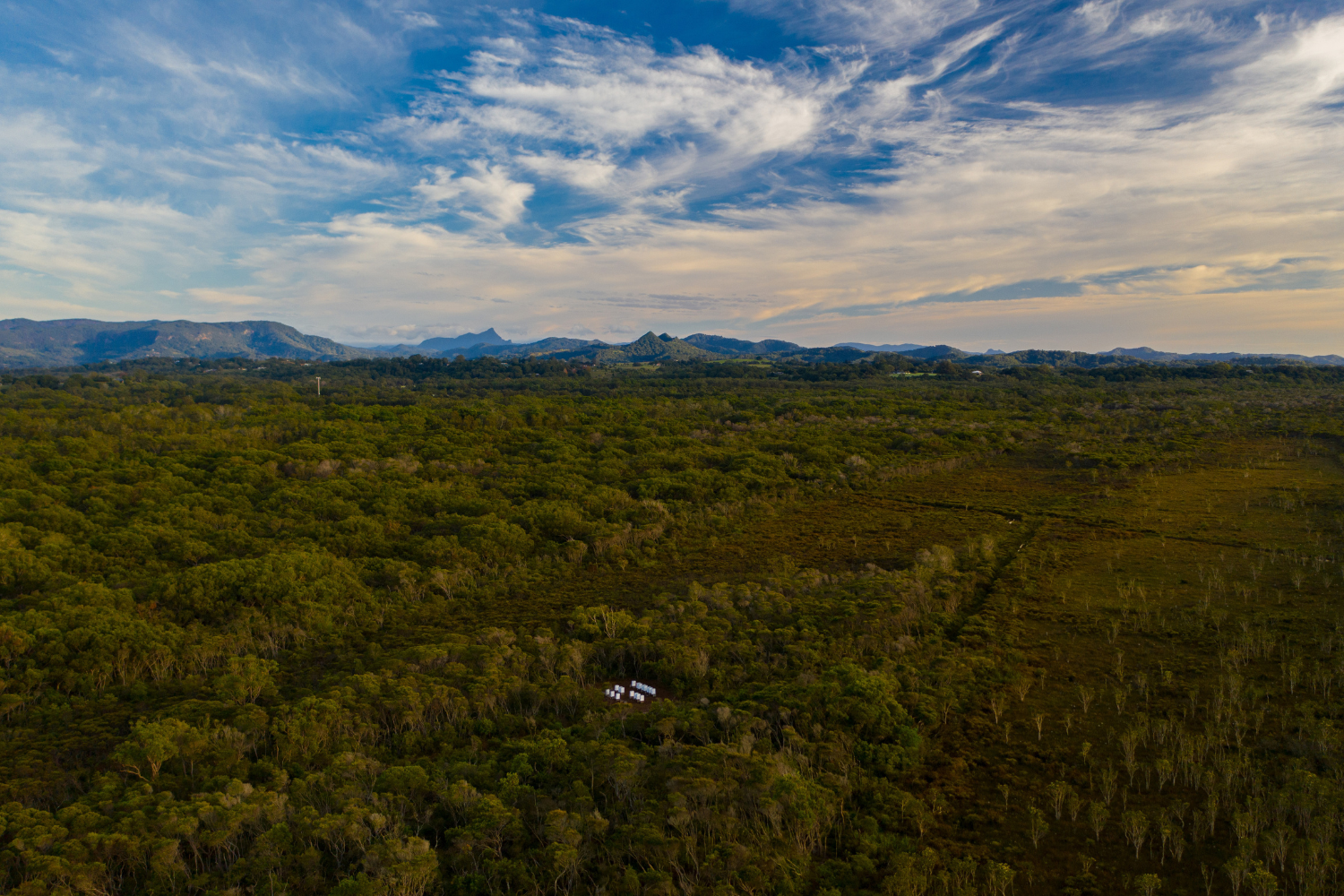
There are four main reasons why the honey we produce is high quality, nourishing and delicious. The first reason is related to how we care for our bees to organic standards without the use of regular sugar feeding or veterinary pharmaceuticals. The second is how we cold extract our honey with minimal processing. The third is our expertise as Master Beekeepers and Manuka honey specialists. The fourth is our location, our bees gather nectar from the pristine coastal forests of Bundjalung country the Northern Rivers area of NSW, Australia.
Beekeeping
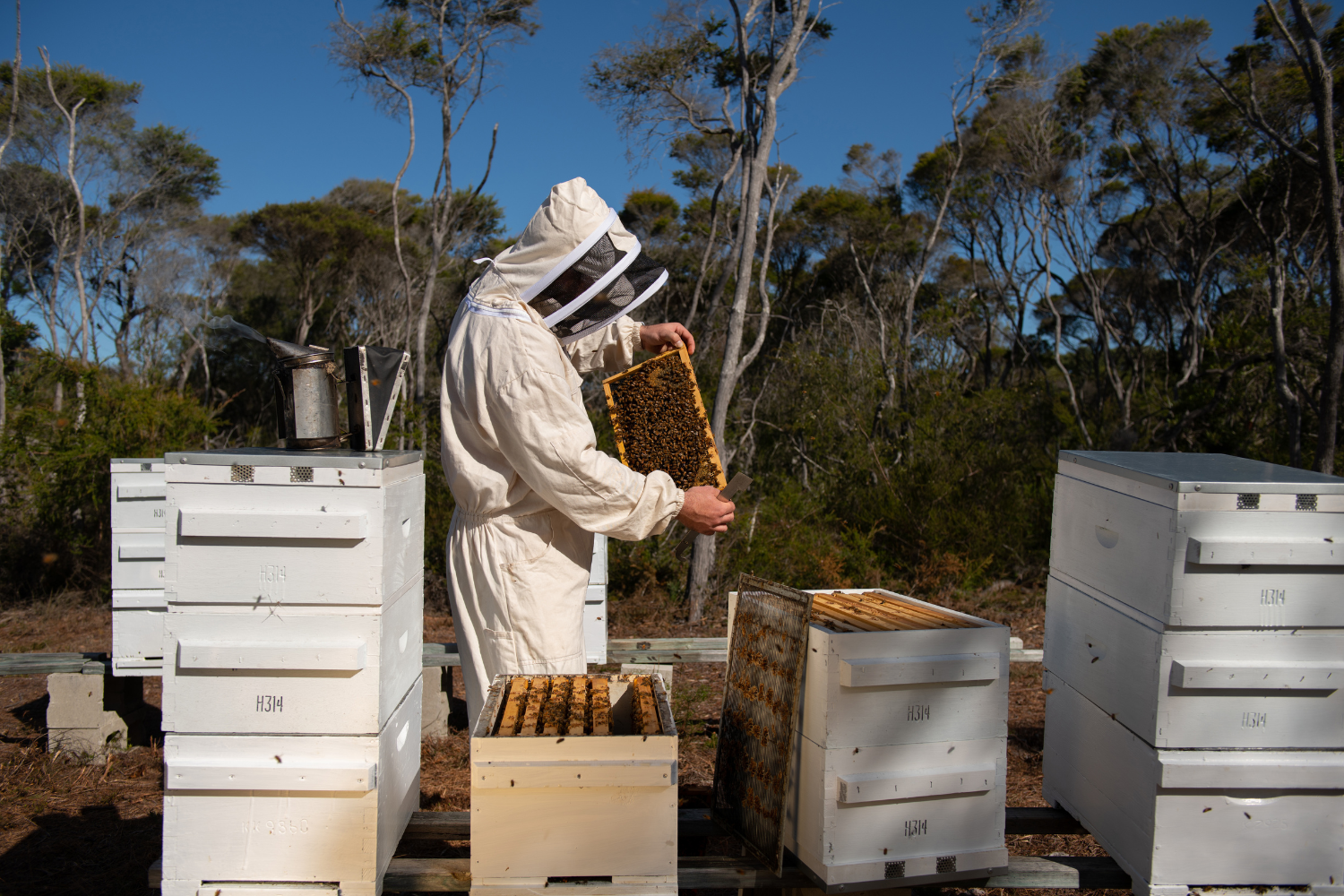
There are many ways of Beekeeping and caring for bees. I like to think of Beekeepers as mothers and you would never tell a mother how to parent so to you would never tell a Beekeeper how to keep their bees. That said there are a few general methods that are take it or leave it. Such as sugar feeding and veterinary pharmaceuticals. Like all farming, Beekeepers do not need to disclose what they feed their bees or what treatments they might give their bees. An Organic farmer will disclose their food is organic to attract customers. A Grass-fed beef farmer will disclose that his cows are Grass-fed (and hopefully finished) to attract customers. As we know the meat produced this way offers superior health benefits both the animal, the person consuming the meat and the environment.
Sugar Feeding Bees
You can think of sugar feeding as Grain fed or not Grass-fed. The beekeeper is feeding the bees sugar just as a beef farmer would feed their cows grains, when the cow should be eating grass and the bees should be using nectar to make honey.
Let’s break down how bees use nectar, bees gather nectar from flowers in their crop which is also called their honey tummy or second tummy. It is not a tummy though, instead it is an expandable pouch which they store nectar and it is separate from their tummy where they digest nutrients. When bees put nectar in their crop they release an enzyme call invertase into the nectar, then they place the nectar into the honey comb and cap it with wax. This enzyme is what turns the nectar into honey in the hive. The honey is stored for food which the bees will eat later. The European honeybee has evolved with us to produce much more honey than the hive needs to eat so we are able to farm some of their honey for ourselves.
Sugar feeding involves preparing a sugar syrup from usually from white sugar and water and making it available to the bees. The bees collect the sugar syrup in their crop and the enzymes works to transform the sugar syrup into honey. Nectar naturally is made up of multiple naturally occurring sugars and other compounds (such as proteins, acids, salts and oils) which make all the different unique honeys. Whereas sugar syrup is made up from sucrose alone. As you can guess that this does affect the quality of the honey produced by the bees.
As beekeepers we are lucky, we live in the subtropics of Australia which means we have seasonal flowerings all year round. We have amazing native Autumn and Winter flowers that not only provide us with unique raw honey but feed our bees through the cold season. In many places where it is colder such as New Zealand and parts of Europe to maintain large apiaries and have strong hives for the Spring flowerings they sugar feed the bees through the cooler months. Other reasons beekeepers sugar feed is because they are pollination beekeepers. This means their main source of income is for pollination services at least for some of the year. For example, beekeepers who pollinate the almond crops would need to feed their bees because the nectar in the almonds is not nutritious enough for the bees and they are often worse off at the end of an almond pollination job. In contrast, we pollinate the Macadamia but the nectar produced by the Macadamia is so rich and healthy for the bees they create our signature Macadamia honey while also growing strong.
We have had instances in extreme weather such drought when there is no nectar in the flowers over Summer. In this case we may resort to sugar feeding for our bees for them to survive. However, we do not sugar feed our bees on a regular seasonal basis because we do not need to and instead aim to move our bees to different seasonal flowers to feed them. During, 2019 /2020 drought we had to sugar-feed some of our bees and some we moved great distances to feed. The trouble with moving bees far away in drought period is the risk of fire and being unable to get to them in time. Which our bees were exposed to but luckily, we did not lose too many.
In 2024, we did a project on sugar testing our Manuka honey and found that on average it contains 0.72g of sugar per 100g compared to other honey which generally sits at around 0.82g of sugar per 100g. We believe this is because we do not sugar feed in the cooler months but also because the honey contains so many other amazing bioactive compounds like MGO there is less space for the sugars.
Veterinary Pharmaceuticals
Veterinary Pharmaceuticals is take or leave it beekeeping method that all beekeepers will decide on. When I refer to Veterinary Pharmaceuticals I refer mainly to antibiotics. Some of these are Oxytetracycline Hydrochloride and Tylosin used to control disease in the hives. If used these treatments are something a beekeeper must use regularly and not just to treat the problem as it arises.
Using these antibiotics makes beekeeping faster and more efficient as you do not need to worry about disease. The benefits of using antibiotics are you eliminate the need for time consuming disease checks and disease management when you find disease. You also limit the need for strict biosecurity in your hive management.
As we do not use antibiotics we have strict biosecurity management of our hives. To achieve this, we manage our hives on an apiary by apiary basis. For us we have around 30-40 bee hives per apiary. This means that when we find disease we can deal with it within the one apiary. When we extract honey, this involves taking the top boxes off the hive and taking them to our honey shed to extract the honey and then putting the empty Stickys (boxes) back onto the hives. We manage each apiary as if it owns all its own boxes and hives. What comes from one apiary to the shed then must go back to the same apiary and even the same hive. This makes our busy season a big juggle and battle for space in our honey shed. When we move hives, the apiary moves together so the hives all stay together. If we need to change the apiary size this is documented so we can refer to if we find disease in one of the apiaries.
If we were treating our bees with antibiotics, then we could send any box or hive to any apiary, and it would not matter. Using antibiotics is faster and more efficient from management perspective when you are caring for a large number of hives. But it will impact the bee’s resistance to disease, leads to antibiotic resistant disease, it impacts and the quality of the honey, can disrupt the bees health and wellbeing and can negatively affect beekeepers.
Tip: buy from local beekeeper and ask if they use antibiotics and regular sugar feeding?
Extracting & Processing
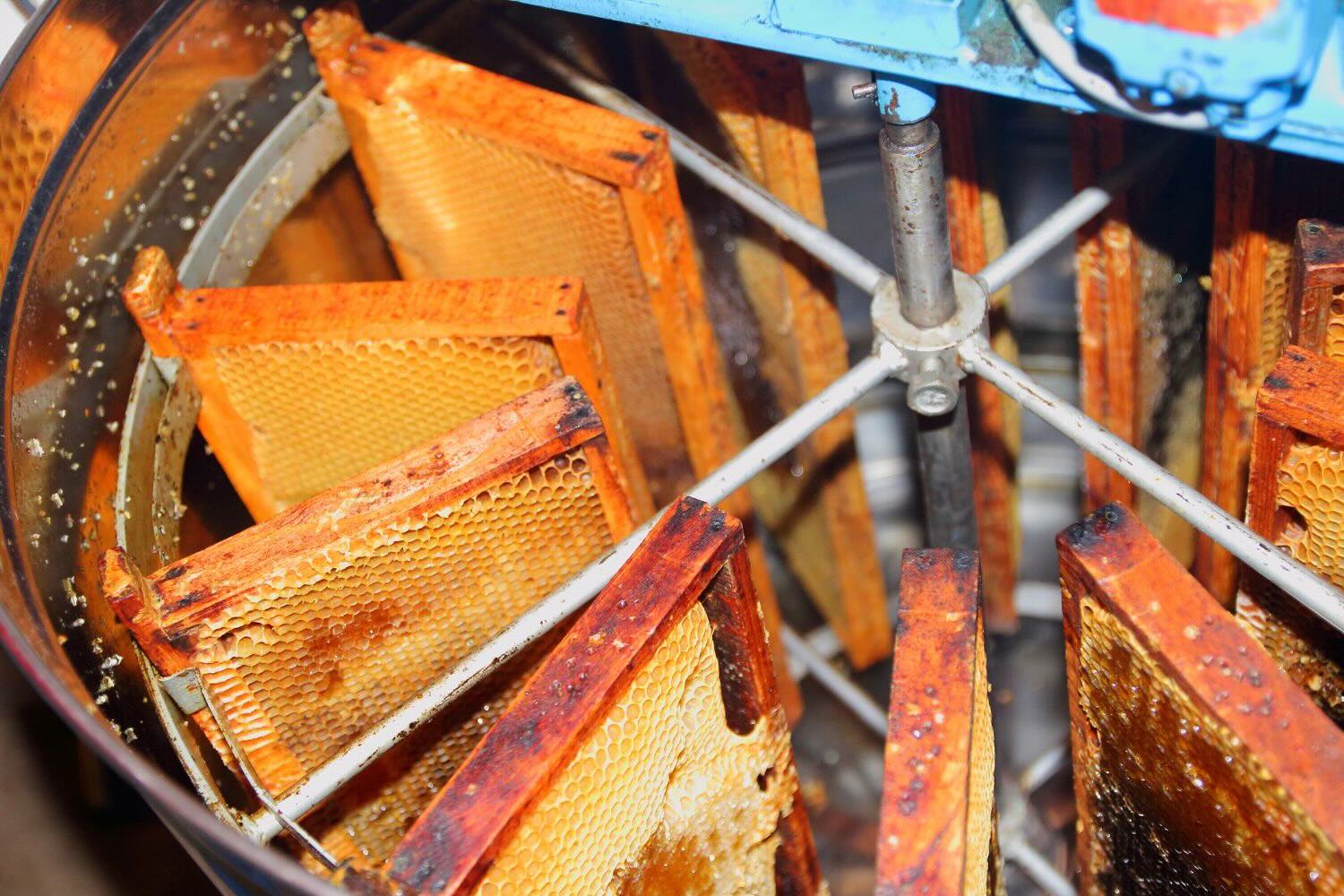
How food is processed or not processed significantly impacts its quality and nutritional density. We use an old cold extraction method which involves slicing the wax caps off the honeycomb with a blade and then spinning the frames to extract the honey. This method is a traditional old slow method, and the honey is not heated during the extraction process. We then use a centrifuge which is again spinning to separate the wax from the honey. Lastly, we push the honey through a 200-micron fabric filter to clean any wax left in the honey.
Some of our honey we cream to stop the crystallisation and make a more uniform product for packing. To do this we do slightly warm the honey to make sure it is runny enough to blend in the creamer tanks. This process of warming is below 40 degrees and the creaming is natural creaming process with nothing other than honey added to the process which is essentially mixing it in the big vat.
We appreciate our season honey varieties which include Macadamia, Eucalyptus, Red Banksia, Wildflower, Coastal Heath, Native Tamarind and of course our Manuka honey. To honour the beautiful honey, the plants and where the honey comes from we generally do not blend or mix our honey. Rather, we jar it as it is so that you can enjoy the different seasonal varieties in their purest and healthiest form.
The other extraction method is hot extraction whereby the frames are heated to make the honey more liquid and the extraction process is completed faster. Other processing methods include blending many different honey varieties together and pasteurising it through heat. The benefit of heating the honey is it will stop the honey crystallising and make it a uniform product. Heating honey changes the nutritional value of the honey. Heating honey changes it to a honey flavoured sugar syrup as the beneficial compounds such as enzymes, amino acids, vitamins, minerals, polyphenols and MGO in the honey are destroyed during the heating process. The natural and easily digested sugars in honey are simple sugars or also changed during heating process to be complex sugars which effectively makes the honey indigestible in our tummys and it must go to the lower intestine to be broken down like processed sugars. This process also affects the Glycaemic Index (GI) of honey, honey generally has a lower GI than processed sugars and some honeys even have a medium GI. When processed with heat however the GI is made higher.
When you see honey labels that read “Australian honey”, unless it says “raw” and “cold extracted”. It has likely once been a beautiful nutritiously dense honey in the hive. Only to be treated with heat for quick extracting and pasteurising. This means you are buying a honey flavoured sugar syrup as the easily digested natural sugars and other health promoting compounds have been destroyed or changed into processed sugars.
Tip: A good way to buy quality honey is to check if it has a seasonal variety, check the packaging says “raw” and “cold extracted”.

Industry Pioneers
Our Directors and Founders Michael Howes and Kat Evans are Australian Manuka industry pioneers. With over 30 year’s experience in producing and selling high quality Australian honey. Michael has worked with the top scientists from University of Sunshine Coast to develop the Australian Manuka honey industry over the past 20 years. Working alongside the scientific research greats, Shona Blair and Peter Brooks. Michael has made a significant contribution to Australian Manuka honey industry. Including the Oz Honey Project which mapped the Australian Manuka plants along the East Coast of Australia and also tested and determined which of the 84 plus varieties in Australia produce the strong MGO honey.
Michael’s other contributions include being a key witness in the court cases which determined who could use the word Manuka honey and the origin of the word. Both cases in the United Kingdom and in New Zealand were won by Australia. That is a story for another day.
Michael’s experience in Beekeeping goes back to high school. Michael beekeeping history alongside his botanical studies and natural health studies was the perfect combination to bring about the Beekeeping and Manuka honey Master he is today. The expertise in beekeeping, cold extraction, handling, tasting, creaming and jarring Australian Manuka honey that Michael has developed over the past 25 years is formidable. He is a true industry leader and has been imparting this knowledge and learning onto his son, daughter and son in law for over 15 years. Caring for bees naturally for the bees and our benefit and therefore producing the highest quality Australian Manuka honey is our family’s passion and vocation.
Our facility we like to call “the honey shed” is a modern and fully certified facility. The honey shed is run on solar and battery power to reduce our carbon footprint. Our honey is produced and packed to high standards including food product health and safety and worker safety. We have the following certifications:
– Hazards Analysis and Critical Control Points (HACCP)
– Good Manufacturing Practices (GMP)
– Export Accredited
– Halal Certification
Testing, Organic Standards & Location
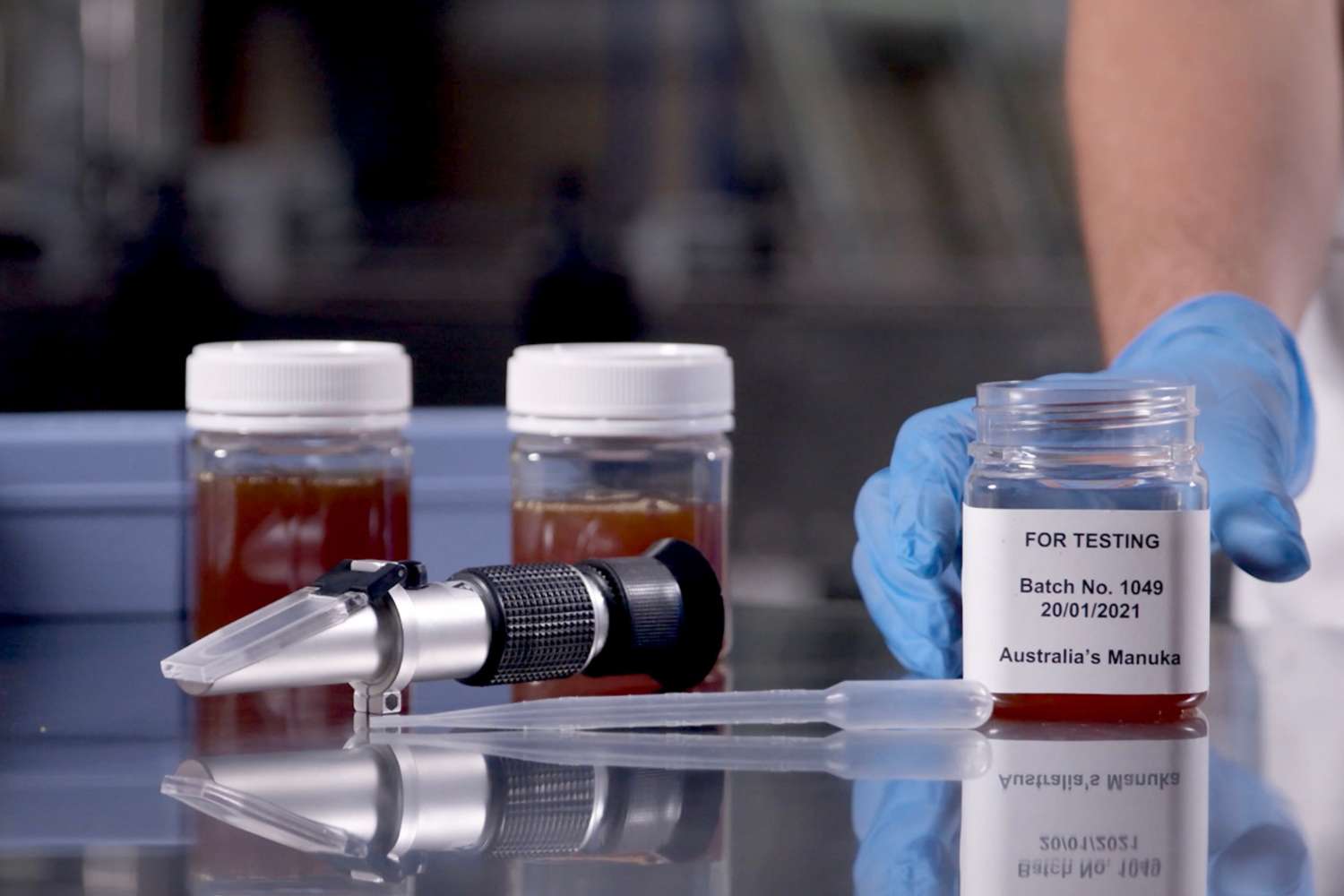
When we refer to testing we are generally referring to Methylglyoxal or MGO testing. We do this through a few laboratories. Firstly, as we have worked closely with University of Sunshine Coast (USC) Honey Lab over the years so we use USC testing while our Manuka honey is maturing. Once our honey is ready for packing into jars we get Analytica tests done as they are Globally accepted lab due to their have NATA Accreditation which is important for customer surety.
We are not certified organic, I do not say this lightly, be sceptical about organic honey. To produce organic certified honey you need to have apiaries at least 5km in every direction from polluted sources such as busy roads, conventional farms (not organic), dumps, industrial centres and townships. The 5km radius is 80 square kms, 19,768 acres or 8,000 hectares, this is a significant area, and the bees need to be in the middle of this space. Therefore, finding places to produce organic honey is extremely difficult. You will need a extremely large organic certified farm, forest or island.
In 2025, we had some comprehensive testing on pesticides in our Manuka honey. These tests showed that there was no pesticide residue in our Manuka honey. This is likely because we gather the majority of our honey on the pristine coastal forest surrounding Byron Bay. That said, we do pollinate the Macadamia orchards in our area to produce our amazing Macadamia honey. Some of these orchards are organic but not all, they do however spray after we pollinate each year, as the sprays are extremely harmful to our bees.
Generally, Australian Manuka honey is less bitter than New Zealand Manuka honey. Our Manuka honey is harvested from the East Coast forests of Australia. The Manuka honey from this area offers a delightful sweet earthy flavoured honey. We are also over 800 kms from the nearest Genetically Modified (GMO) crops which are in the far Western slopes of NSW and are Canola and Cotton crops. This means that there is no chance for our bees to forage nectar from Genetically Modified crops.
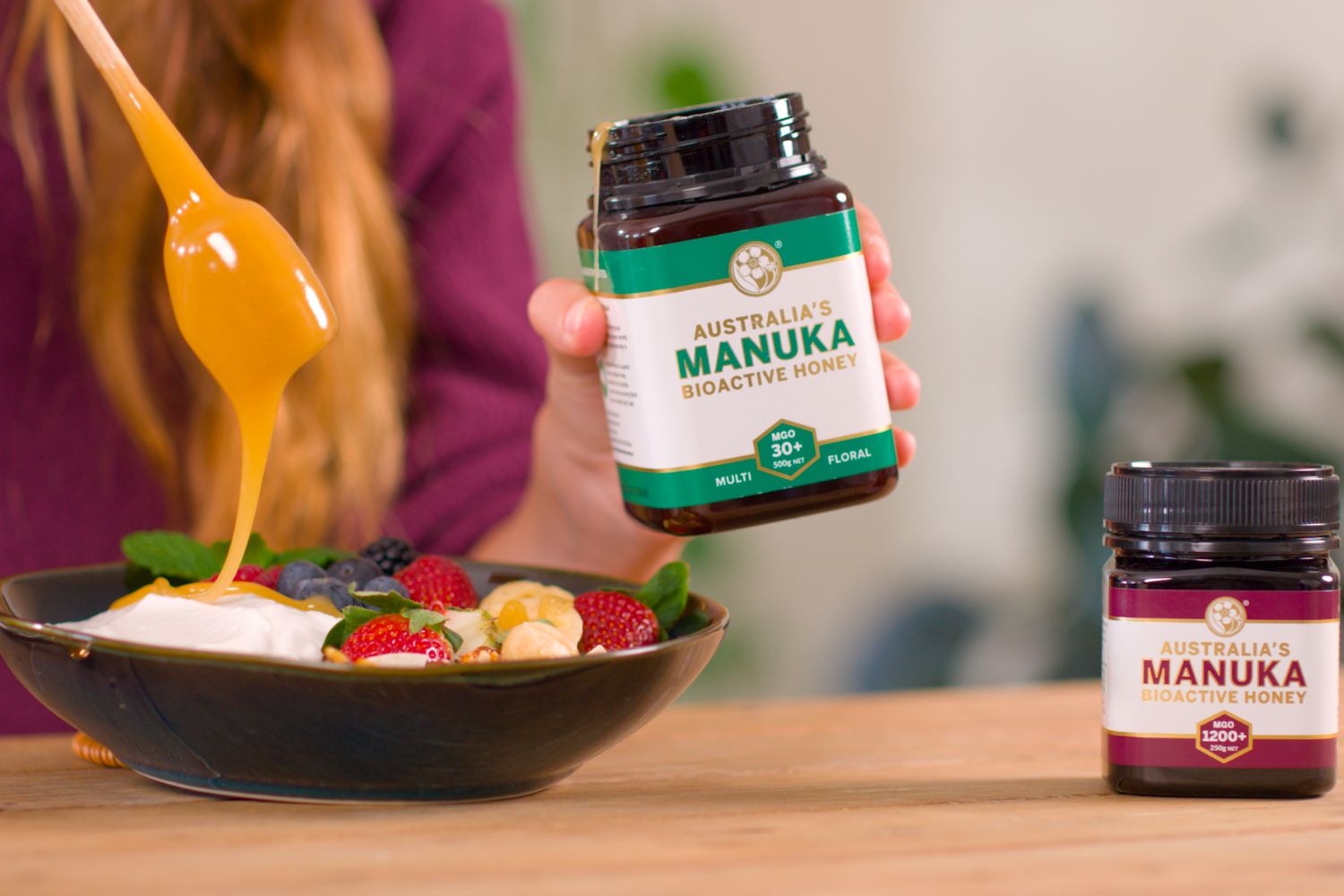
You can buy our delicious Australian Manuka honey direct from us at Byron Farmers Market, in stores and online direct on our website. We are also available on Amazon in Australia and Japan.
I wish you would offer a ready made salad dressing under your brand for busy people to buy …so much easier!
Hi Dehlia we would love to be able offer that type of product. You could try our Superfoods Mullum Plum and mix it with come vinegar and oil – this makes a beautiful fresh sweet and sour native foods dressing. Thanks Australias Manuka Team